
More than 40 people came to find out.
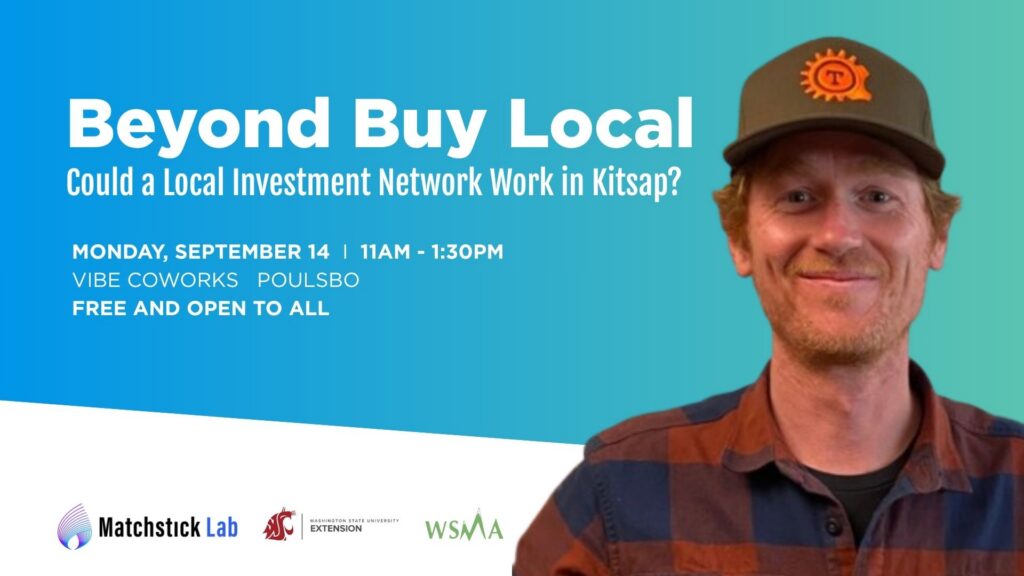
On Monday, September 14, 2026 more than 40 people gathered at Vibe Coworks to explore two important questions:
Does Kitsap need another way to get capital into the hands of local entrepreneurs?
And could a Local Investment Network help provide it?
By the end of the session, people were already asking what it would take to get started.
The room was full of people who don’t necessarily find themselves in the same conversation often: business owners, nonprofit leaders, bankers and lenders, investors, economic development partners and community members curious about putting some of their own money to work closer to home.
They came from across Kitsap—and from Jefferson County, Edmonds, Port Angeles, Olympia and Twisp—to share and learn about Local Investment Networks, or LINs.
The gathering was part of Matchstick Lab’s broader effort to understand the capital gaps facing Kitsap entrepreneurs and explore what we might build to address them. That work is supported by a Growth Accelerator Fund Competition award from the U.S. Small Business Administration.
Monday’s event took shape in close partnership with Lisa Smith, Executive Director of the Washington State Microenterprise Association, who was instrumental in bringing the right people and resources together to make it happen. WSMA also sponsored the event.
In the days leading up to it, Lisa made the case for looking beyond “buy local” in her Kitsap Business article, What If “Buy Local” Was Just the Beginning? We already understand how purchasing from local businesses strengthens a community. A LIN asks us to consider another possibility: What if we could invest in them, too?
So, what exactly is a LIN?
What exactly is a Local Investment Network?
At its simplest, a LIN connects local businesses that need capital with local people who may be interested in investing in them.
It isn’t a bank. It isn’t a pooled fund or a committee deciding where everyone’s money should go. Each investment is a direct, private agreement between an individual and a business owner they’ve taken the time to know.
Think of it as taking “buy local” one big step further.
What Local Investing Looks Like in Practice
According to the WSU Snohomish County Extension office, LINs have already helped facilitate more than 300 investments, directing over $8 million into local businesses and helping create or retain more than 178 jobs across Washington state alone.
Bill Wise showed us what local investing can look like after 16 years in Jefferson County. Through the Jefferson County Local Investment Opportunity Network (LION), 58 community members have made more than 400 investments in Jefferson County totaling at least $13.8 million. Most have been loans, and more than two-thirds were for $20,000 or less, with terms worked out directly between the investor and recipient.
The statistics were impressive, but what really hit home was when Bill talked about why he continues to invest locally. He became visibly emotional, and the whole room felt it. “It feels good,” he said.
It was only three words, but they captured something important.
This isn’t simply about moving money. It’s about helping build the community you want to live in.
Patrick Law of TwispWorks gave us a look at the newer Methow Investment Network, which has grown to more than 80 investor members and helped 32 businesses access $3.7 million since 2018.
Their average investment is approximately $75,000, but the range is striking: the smallest has been $6,000, while the largest is approaching $500,000. That helped make the possibilities feel much more tangible. A local investment might help a business purchase a critical piece of equipment, open its doors, expand into a new space or take on a much larger project.
He also showed us how much happens before an entrepreneur ever meets a potential investor. TwispWorks helps applicants develop a business plan, prepare financial statements and build a pitch. Interested investors and business owners then get to know one another and negotiate their own terms.
That preparation matters. A LIN doesn’t simply introduce people with money to people who need it. Done well, it helps entrepreneurs become better prepared for investment while connecting them to advice, relationships and technical support that can be just as valuable as the capital itself.
Anthony Gromko of WSU Extension helped us understand how LINs fit into a community’s broader business-support and capital ecosystem.
Want to dig deeper?
Then We Turned the Question to Kitsap
There was no shortage of audience questions, thoughts, and ideas. People talked about risk, trust, investor education and what entrepreneurs need to be ready for this kind of capital. There were discussions about how a LIN could complement traditional lending, and broadened pathways to entrepreneurship—and even home ownership—for people across Kitsap. People who had never thought of themselves as investors began to see how they might participate.
The conversation was clear-eyed. LINs require patient relationship-building, strong support for entrepreneurs and consistent coordination behind the scenes. Important questions remain about how a Kitsap network should be structured, where it should be housed and what support it would need to succeed.
None of those questions seemed to dampen the interest in the room.
Where We Go From Here
No, we’re not announcing the launch of a Kitsap LIN just yet.
We’re doing the work that needs to come first: learning from communities with real experience, listening to potential investors and entrepreneurs, and identifying the people and partnerships needed to build something that can last.
Monday made one thing abundantly clear: Kitsap has people who believe in local entrepreneurs. We have experience, relationships, ideas and capital. We also have plenty of people interested in helping connect those dots.
Matchstick Lab will continue convening this conversation as part of our broader capital-access work. Our next step is to bring interested people together and dig further into what a Kitsap LIN could look like, how it could be organized and supported, and what it would take to move from interest to action.
Our enormous thanks to Lisa Smith and the Washington State Microenterprise Association for sponsoring the event; to WSU Extension for helping organize and support it; and to Anthony, Bill and Patrick for sharing their hard-earned lessons so openly.
Now, we want to hear from you.
If you’re a potential investor, entrepreneur, lender, advisor, community partner or simply someone willing to help build the next piece of Kitsap’s entrepreneurial ecosystem, come out of the woodwork!
Tell us what interests you, what experience you bring and how you might want to be involved.
Let’s figure out what it would take to build this together.